The Gap Between What We Say We Value and What We Reinforce is Where Turnover Lives
“ What the limited ABA retention literature actually shows, and why compensation-focused interventions may be aimed at the wrong variable.” - Denise Freeman DeCandia
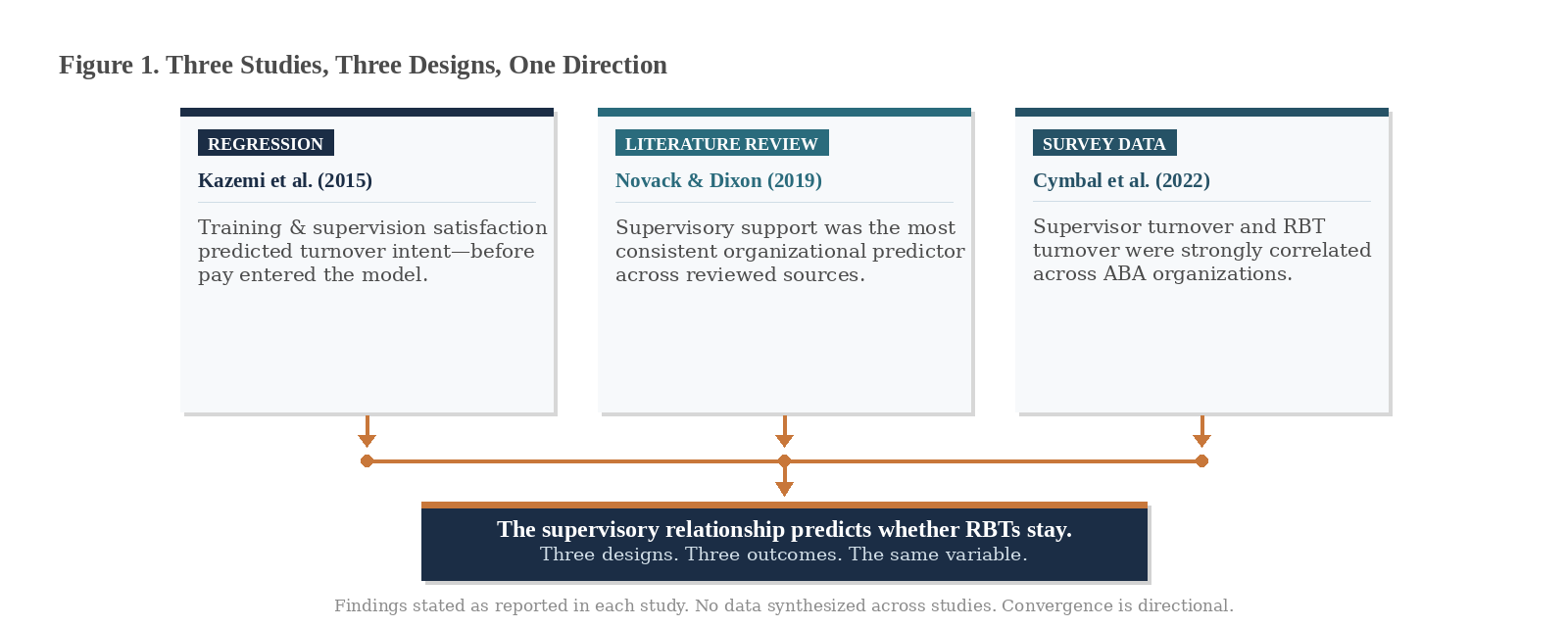
Registered behavior technician turnover has been described as one of the most persistent workforce challenges in applied behavior analysis. Wine et al. (2020) documented it as a systemic problem in human services organizations with direct consequences for service continuity and client outcomes. Cymbal et al. (2022), analyzing BHCOE® survey data across multiple ABA organizations, found that supervisor turnover and RBT turnover rates were strongly correlated — when supervisors left, technicians tended to follow. That finding deserves more attention than it typically receives. It points the intervention arrow away from the RBT and toward the organizational structure surrounding them. The field’s response to turnover has largely not followed that direction.
Most organizational responses to RBT attrition focus on compensation adjustments, scheduling flexibility, and morale initiatives. These are not irrelevant variables. But the research that exists, limited as it is, suggests they are not where the highest predictive weight sits.
What the limited literature actually shows
Kazemi et al. (2015) found that satisfaction with training, supervision, and pay all significantly predicted turnover intent among behavior technicians. In their hierarchical regression model, satisfaction with training alone accounted for 8.8% of the variance in turnover intent; adding supervision brought that to 14.3%; adding pay brought it to 20.8%; and the full model accounted for 37.9% of the variance. This was not a large-scale study. It was a targeted analysis of a specific population, and its findings were directional, not definitive. But the direction it pointed was clear: the supervisory relationship and training quality were significant predictors of intention to leave, alongside compensation.
Novack and Dixon (2019) reviewed the available literature on burnout, job satisfaction, and turnover in behavior technicians and found perceived supervisory support to be the most consistent organizational predictor across their reviewed sources. Again, the literature base was limited. The pattern across it was not.
Supervisor turnover and RBT turnover rates were strongly correlated across ABA organizations — when supervisors left, technicians tended to follow. (Cymbal et al., 2022)
Blackman et al. (2024), surveying BCBAs who had left a previous position, found that burnout was the top contributor to BCBA turnover, endorsed by 59.8% of respondents. Pay and benefits, supervision and mentorship, collegiality and professional relationships, and ethical violations were also frequently cited as contributing factors — each endorsed at roughly similar rates. Within the burnout category specifically, respondents identified unreasonable workload expectations and poor leadership as common contributing themes. Slowiak and DeLongchamp (2022), examining self-care strategies and job-crafting practices among behavior analysts, found that 72% of 826 ABA practitioners reported medium to high levels of burnout, and that both self-care strategies and job-crafting practices strongly predicted work-life balance, work engagement, and burnout outcomes above and beyond demographic variables.
Taken together, these studies describe a pattern in which what practitioners understood they were entering when they accepted a role and what the organizational environment actually reinforced were not the same thing. That gap — between what an organization says it values and what its consequence system actually reinforces — is where the retention problem lives. Compensation adjustments do not close it.
The organizational psychology that the field has not imported
The research base on what produces retention in organizations extends well beyond ABA. O’Reilly et al. (1991), in a longitudinal study, found that values congruence between employees and their organization predicted job satisfaction and organizational commitment at one year and actual turnover at two years, over and above initial satisfaction scores — the foundational study that established this relationship empirically. Vandenberghe (1999) replicated the pattern in health care, finding that person-organization values congruence at entry predicted staff retention one year later. Kristof-Brown et al. (2023), in a comprehensive review of the accumulated person-organization fit literature in Personnel Psychology, confirmed the relationship has held across decades of research, with meta-analytic effect sizes showing person-organization fit negatively related to turnover intention (reliability-corrected ρ = -.21 to -.58 depending on measurement approach).
This research does not measure whether employees like their supervisor or find their job meaningful in a general sense. It measures whether what the employee understood the organization to value when they joined matches what the consequence system actually and consistently reinforces once they are inside it. When those two things align, people stay. When they diverge, people leave, often without being able to fully articulate why, because the divergence operates at the level of daily contingencies rather than explicit policy.
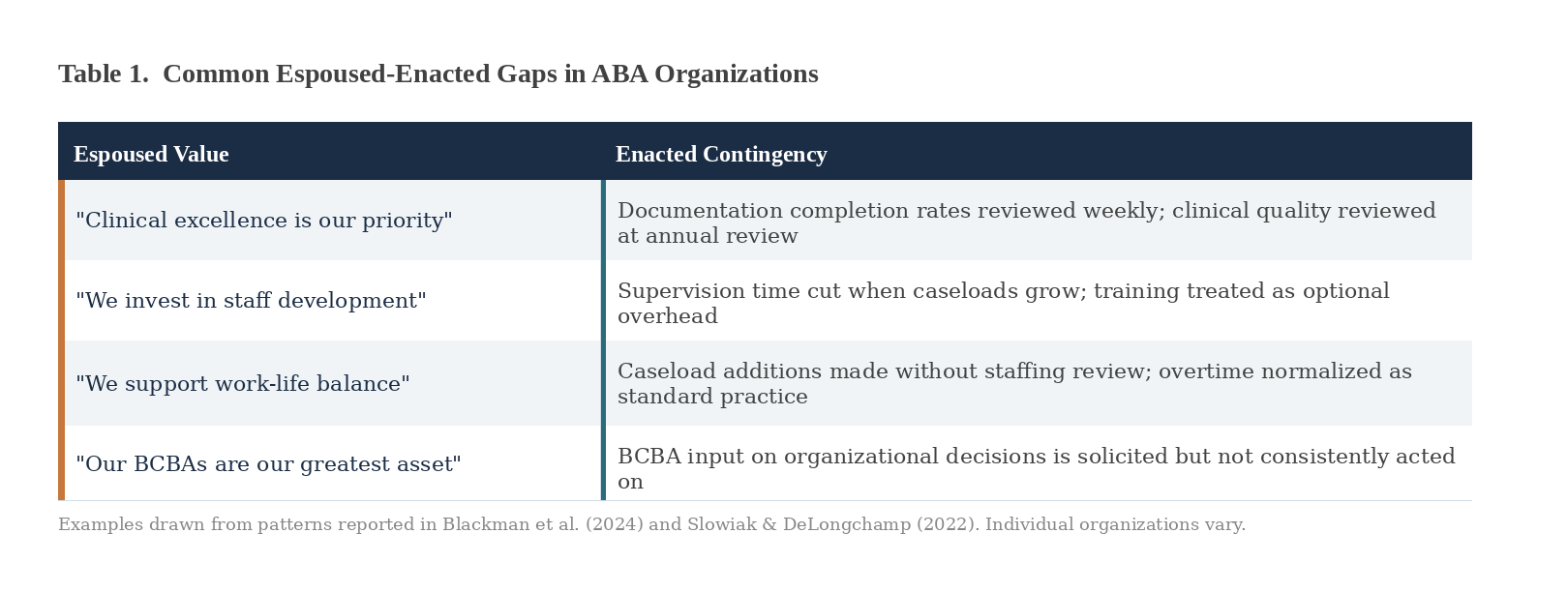
Denison and Mishra (1995), in empirical research across 764 organizations, found that four organizational culture traits — involvement, consistency, adaptability, and mission — were systematically linked to organizational effectiveness. Consistency, in particular, captures the degree to which an organization’s values and practices are reliably enacted across roles, settings, and time. Culture, in that framework, is not a personality or a climate score. It is a measurable property of the alignment between stated values and actual organizational behavior. Organizations with high consistency produced different outcomes than those without it, regardless of what their stated values described.
Where the BCBA sits in this picture
In most ABA service delivery arrangements, the BCBA assigned to a caseload is the primary and often the only consistent organizational touchpoint an RBT has across the workweek. What that RBT understands about what the organization actually expects, what it reinforces, and what standard of care it holds does not come primarily from onboarding materials or organizational communications. It comes from the day-to-day pattern of what their BCBA responds to, acknowledges, corrects, and ignores.
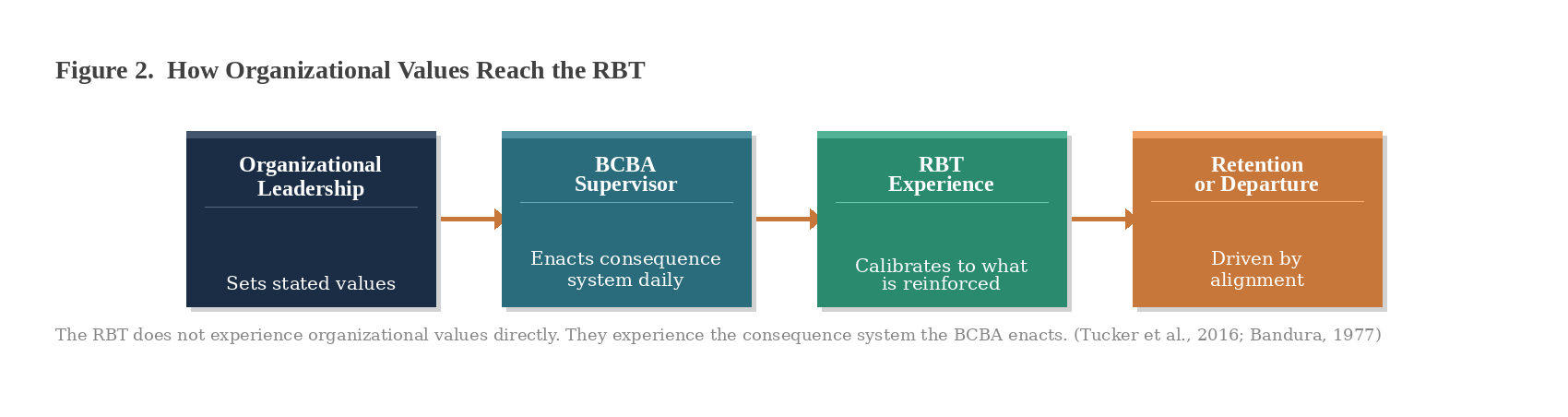
The RBT does not experience organizational values directly. They experience the consequence system the BCBA enacts in daily supervisory interactions. Alignment between espoused and enacted values at the supervisory level predicts whether the RBT’s experience matches what drew them to the role.
Tucker et al. (2016), examining how chief executive officers influence organizational safety climate and employee injuries, found that organizational priorities set at the leadership level cascaded to frontline staff through supervisory behavior, not through communication alone. What supervisors did determined what frontline staff understood to be expected and reinforced. The mechanism was behavioral observation. That pattern maps directly onto how ABA organizations function.
This means the BCBA’s supervisory behavior is not only a clinical quality variable. It is the primary channel through which the RBT’s experience of organizational values is constructed. A BCBA who delivers non-differential feedback, who does not make the connection between an RBT’s specific behavior and the standard it reflects or fails to meet, is transmitting a consequence system in which equivalent and non-equivalent behaviors produce equivalent responses. That is the environmental condition the retention literature describes as predictive of departure.
Why compensation-focused interventions are aimed at the wrong variable
Compensation matters. It is a necessary condition for employment, and chronic underpayment is its own organizational failure. But in high-turnover service contexts specifically, McCulloch and Turban (2007) found that a person-organization fit measure predicted continued length of service beyond cognitive ability and technical qualifications — a finding that replicates the meta-analytic pattern in a setting structurally similar to ABA service delivery. Compensation was not the variable with the most predictive weight in that context either.
The implication is not that wages should be ignored. It is that an organization investing primarily in compensation adjustments to solve a turnover problem driven by supervisory inconsistency and espoused-enacted value gaps is applying an intervention that addresses a real but secondary variable. The research, limited as it is, points consistently toward the supervisory relationship and the alignment between what the organization reinforces and what practitioners expected when they joined.
The field has the tools to address both of those variables. Behavioral skills training methods that produce clinical competency have been documented and validated (Parsons et al., 2012). The specific characteristics of performance feedback that determine whether it functions as an effective reinforcer in organizational settings are described in the literature (Alvero et al., 2001; Gravina et al., 2018). What has not happened systematically is the application of those tools to supervisory behavior as an organizational culture variable rather than only as a clinical training structure.
That is the question the retention literature, read carefully and honestly, points toward: not why do RBTs leave, but what does the consequence system they work inside of actually reinforce, and is that the system the organization claims to be running? If the field is serious about retention, the intervention target is not the RBT’s compensation package. It is the alignment between what organizations say they value and what their supervisory consequence systems actually reinforce. The research, limited as it is, has been pointing in that direction for years.
References
Alvero, A. M., Bucklin, B. R., & Austin, J. (2001). An objective review of the effectiveness and essential characteristics of performance feedback in organizational settings (1985–1998). Journal of Organizational Behavior Management, 21(1), 3–29. https://doi.org/10.1300/J075v21n01_02
Blackman, A. L., Ruby, S. A., Wine, B., Reed, D. D., & Li, Y. (2024). An analysis of variables contributing to Board Certified Behavior Analyst® turnover. Behavior Analysis in Practice, 18, 1124–1138. https://doi.org/10.1007/s40617-024-00998-y
Cymbal, D. J., Litvak, S., Wilder, D. A., & Burns, G. N. (2022). An examination of variables that predict turnover, staff and caregiver satisfaction in behavior-analytic organizations. Journal of Organizational Behavior Management, 42(1), 36–55. https://doi.org/10.1080/01608061.2021.1910099
Denison, D. R., & Mishra, A. K. (1995). Toward a theory of organizational culture and effectiveness. Organization Science, 6(2), 204–223. https://doi.org/10.1287/orsc.6.2.204
Gravina, N., Villacorta, J., Albert, K., Clark, R., Curry, S., & Wilder, D. A. (2018). A literature review of organizational behavior management interventions in human service settings from 1990 to 2016. Journal of Organizational Behavior Management, 38(2–3), 191–224. https://doi.org/10.1080/01608061.2018.1454872
Kazemi, E., Shapiro, M., & Kavner, A. (2015). Predictors of intention to turnover in behavior technicians working with individuals with autism spectrum disorder. Research in Autism Spectrum Disorders, 17, 106–115. https://doi.org/10.1016/j.rasd.2015.06.012
Kristof-Brown, A. L., Schneider, B., & Su, R. (2023). Person-organization fit theory and research: Conundrums, conclusions, and calls to action. Personnel Psychology, 76, 375–412. https://doi.org/10.1111/peps.12581
McCulloch, M. C., & Turban, D. B. (2007). Using person–organization fit to select employees for high-turnover jobs. International Journal of Selection and Assessment, 15(1), 63–71. https://doi.org/10.1111/j.1468-2389.2007.00368.x
Novack, M. N., & Dixon, D. R. (2019). Predictors of burnout, job satisfaction, and turnover in behavior technicians working with individuals with autism spectrum disorder. Review Journal of Autism and Developmental Disorders, 6, 413–421. https://doi.org/10.1007/s40489-019-00171-0
O’Reilly, C. A., Chatman, J. A., & Caldwell, D. F. (1991). People and organizational culture: A profile comparison approach to assessing person-organization fit. Academy of Management Journal, 34(3), 487–516. https://doi.org/10.2307/256404
Parsons, M. B., Rollyson, J. H., & Reid, D. H. (2012). Evidence-based staff training: A guide for practitioners. Behavior Analysis in Practice, 5(2), 2–11. https://doi.org/10.1007/BF03391819
Slowiak, J. M., & DeLongchamp, A. C. (2022). Self-care strategies and job-crafting practices among behavior analysts: Do they predict perceptions of work–life balance, work engagement, and burnout? Behavior Analysis in Practice, 15, 414–432. https://doi.org/10.1007/s40617-021-00570-y
Tucker, S., Ogunfowora, B., & Ehr, D. (2016). Safety in the C-suite: How chief executive officers influence organizational safety climate and employee injuries. Journal of Applied Psychology, 101(9), 1228–1239. https://doi.org/10.1037/apl0000116
Vandenberghe, C. (1999). Organizational culture, person–culture fit, and turnover: A replication in the health care industry. Journal of Organizational Behavior, 20(2), 175–184. https://doi.org/10.1002/(SICI)1099-1379(199903)20:2<175::AID-JOB882>3.0.CO;2-E
Wine, B., Osborne, M. R., & Newcomb, E. T. (2020). On turnover in human services. Behavior Analysis in Practice, 13, 492–501. https://doi.org/10.1007/s40617-019-00399-6