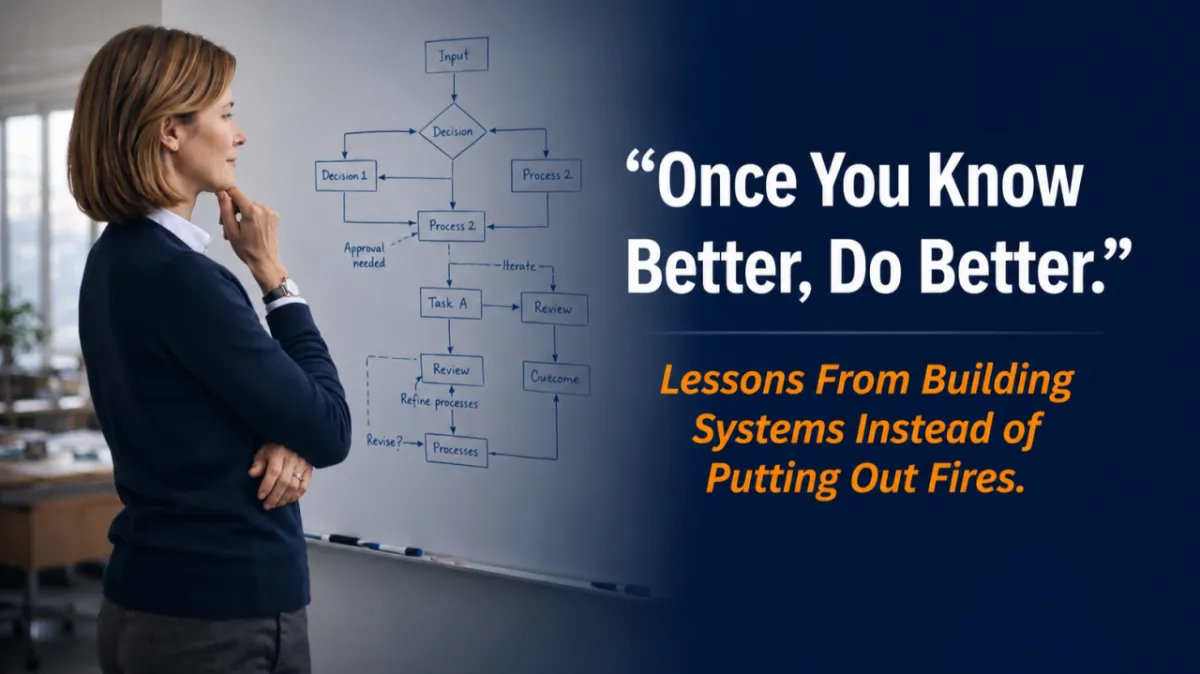
Once You Know Better, Do Better: Lessons From Building Systems Instead of Putting Out Fires
“Once you know better, do better.”- Maya Angelou
For most of my career, I thought being a good leader meant being fast, responsive, and always available. I prided myself on my ability to jump in, solve problems, and keep things moving. As an entrepreneur, especially in the early days of building my business, that mindset felt necessary. There was always another fire to put out, another decision to make, another problem that needed immediate attention.
And for a long time, it worked. Or at least, it worked well enough.
But what I did not realize then is that I was confusing motion with progress, and responsiveness with leadership. I was running hard, but not always running in the right direction.
The moment that truly forced me to confront this came during audit season.
Anyone who has been through healthcare audits knows the feeling. The sudden urgency. The scramble for documentation. The stress of realizing that the information you need is scattered across systems, inboxes, and people who may no longer even be with your organization.
I remember sitting there thinking: “We are doing good work. We are ethical. We care deeply about clinical quality. So why does this feel so chaotic?”
The answer was uncomfortable but simple. We did not have systems that matched the scale we had reached.
We had grown beyond the point where informal processes, tribal knowledge, and good intentions were enough. What worked when we were two or three people no longer worked when we were twenty, fifty, or more. And instead of proactively building the structure we needed, I had stayed in reactive mode far too long.
I told myself I did not have time to build systems because I was too busy running the business.
In reality, I did not have systems because I was too busy running the business.
That distinction changed everything.
When Stress Becomes a Signal
The audits exposed gaps that had been quietly accumulating for years. Clinical notes were not uploaded in a way that was easy to retrieve. Missing signatures from staff who were no longer with the company. Contract updates from payers that were poorly communicated. Requirements that changed without clear notice.
None of these were ethical failures. They were structural failures.
We were trying to operate a growing organization on foundations that were built for something much smaller.
At the time, it felt overwhelming. Every new request meant stopping what I was doing to respond. Every issue required my personal involvement. The business could not move forward without me constantly stepping in.
That level of dependence on one person is not leadership. It is fragility disguised as dedication.
What I eventually realized is that chronic stress is often a signal that the system is misaligned. Not that the people are failing. Not that the mission is wrong. But the structure no longer fits the reality.
And once I truly saw that, I could not unsee it.
Building Instead of Reacting
The shift did not happen overnight. It happened one decision at a time.
I started by investing in better tools so the team could consistently upload materials to the right place. Then I added safeguards into those systems to flag when things were missing or incomplete.
I promoted someone whose role was specifically focused on auditing clinical notes and requirements.
I put recurring time on my calendar to contact payers every month, not because I distrusted them, but because I accepted that communication breakdowns were part of reality and that responsibility ultimately sat with me.
I built internal calendars for communication. I reinvested in HR processes so training and development were not just happening, but being documented in a way that made sense.
Most importantly, I began writing SOPs for everything.
Not because I wanted bureaucracy. But because I wanted clarity.
I wanted people to know exactly what was expected, how to do it, and how success would be measured. I wanted to remove guesswork, reduce ambiguity, and create an environment where people could actually succeed without needing me in every conversation.
As a behavior analyst, this part was humbling.
I knew the science. I taught others about task analysis, operational definitions, and reinforcement systems every day. But I had not fully applied those principles to my own leadership until I was forced to.
Once I did, everything changed.
The business became calmer. The team became more confident. I became a better communicator. Not because I worked harder, but because I worked differently.
The Cost of Waiting Too Long
One of the hardest parts of reflecting on this now is acknowledging the cost of not doing it sooner.
Not just financially. But relationally.
There are people I lost along the way who were incredible. Talented. Ethical. The kind of people you want to build something with long term.
But without strong systems, even great people eventually burn out, get frustrated, or feel unsupported. And when that happens, the loss is not just operational. It is personal.
If I am being honest, some of the mistakes I made were not because I did not care. They were because I did not yet know how to lead at that level.
And that is where the Maya Angelou quote keeps coming back to me.
Once you know better, do better.
Not in a shame-based way. In a responsibility-based way.
There is a point in every leader’s journey where ignorance stops being an excuse. Where growth requires not just effort, but intention.
I reached that point later than I wish I had.
The Clinician to Leader Gap
Like many in our field, I came up as a clinician. I was trained to serve clients, supervise staff, and make data-driven decisions. I was not trained to build scalable systems, design organizational structures, or think strategically about growth.
I knew I needed mentorship. I just did not know where to find it.
There were moments when I felt isolated. Responsible for everything, but unsure how to evolve beyond the role I had outgrown.
Looking back, I see now that this is one of the biggest gaps in our industry. We promote strong clinicians into leadership without equipping them to lead organizations. Then we wonder why burnout is so high and turnover is so constant.
We would never expect an RBT to master complex clinical skills without supervision. Yet we routinely expect business owners and clinical directors to figure out leadership on their own.
That makes no sense.
Leadership is a skill set. Systems design is a discipline. Organizational growth is a science in its own right.
And pretending otherwise does not make us resilient. It makes us vulnerable.
No Matter Your Path, Systems Matter
What I care most about now is not how big a company gets, or whether it eventually partners with private equity, or remains independent, or takes some hybrid path in between.
What I care about is whether leaders are building something that is sustainable, ethical, and aligned with their values.
No matter your long-term plan, you need systems.
If you plan to stay small, systems protect your time and your sanity. If you plan to scale, systems protect your culture and your people. If you plan to partner, systems protect your legacy.
There is no version of success where structure does not matter.
And yet, so many leaders stay in firefighter mode for years because it feels urgent. Necessary. Noble, even.
Until one day, they realize that the very thing they avoided building is the only thing that would have freed them.
Thinking Bigger
More recently, my perspective has shifted again.
A cancer diagnosis has a way of forcing reflection. It compresses time. It sharpens priorities. It makes you ask questions that are easy to avoid when life feels endless.
For me, one of those questions has been: How can I help more people with what I have learned?
Not in a dramatic way. Not in a savior way. But in a grounded, practical way.
How can I share the lessons I paid for through experience, stress, mistakes, and growth so that others don’t have to learn them the hardest way possible?
I think bigger now. Not in terms of scale, but in terms of impact.
If I can help one leader move out of constant reactivity, that matters. If I can help one company build systems before a crisis hits, that matters. If I can normalize seeking guidance instead of carrying everything alone, that matters.
We do not need more heroic leaders. We need more supported ones.
What I Know Now
Here is what I know now, with clarity I did not have then.
Being busy is not the same as being effective. Being needed is not the same as being a leader. And building systems is not a distraction from real work. It is the real work.
If you feel constantly behind, constantly reacting, constantly holding everything together with your own energy, that is not a personal failure.
It is a structural one.
And it can be changed.
Not through hustle. Not through burnout. But through intention, clarity, and support.
Once you know better, do better.
Not perfectly. Not all at once. But steadily, thoughtfully, and with the courage to admit that leadership is something we all have to learn.
Including me.