Organizational Support as Reinforcement
A Behavior-Analytic Approach to Retention
Retention is one of the most pressing challenges facing ABA organizations today. RBT turnover disrupts continuity of care, impacts client outcomes, and creates unsustainable workloads for remaining staff. These aren’t soft organizational issues; they’re clinical and ethical issues.
Most organizations approach retention through trial and error: higher pay, flexible schedules, wellness programs. We implement interventions without measurement. We don’t systematically diagnose why people leave.
But here’s what behavior analysis teaches us: Behavior is shaped by environmental contingencies. If we want to understand why people stay or leave, we need to look at the reinforcement patterns embedded in organizational systems.
This is where Perceived Organizational Support becomes functionally important.
Organizational Support as Reinforcement
From a behavior-analytic perspective, Perceived Organizational Support (POS) reflects the degree to which employees experience their organization as a source of reinforcement and positive stimulus control.
When employees perceive that their organization values their contributions, recognizes their effort, treats them fairly, and cares about their well-being, they are responding to patterns of reinforcement embedded in organizational contingencies. These reinforcement patterns shape their behavior, including the decision to stay or leave.
Conversely, when organizational contingencies fail to reinforce valued behaviors, when recognition is absent, when treatment is inconsistent, or when employees perceive indifference to their welfare, the organization functions as an extinction or punishment context. Under these conditions, employees seek reinforcement elsewhere, often by leaving.
This isn’t speculation. The research is clear: Perceived Organizational Support predicts retention across industries and organizational types (Eisenberger et al., 1986; Eisenberger et al., 2020).
Why This Matters to Behavior Analysts and ABA Organizations
As a BCBA and organizational development and leadership scholar, I work in spaces where we understand behavior through the lens of reinforcement, stimulus control, and contingencies. Yet when it comes to organizational support and retention, we often default to generic HR solutions rather than applying our own principles.
This is the gap I want to address.
We know that behavior is shaped by environmental contingencies. We know that measurement drives change. We know that observable behavior matters more than intentions. These principles apply to leadership behavior and organizational systems just as they apply to clinical behavior.
Perceived Organizational Support is well-researched and well-validated across industries. The Survey of Perceived Organizational Support (SPOS) is a robust measurement tool. The evidence is clear: how employees perceive organizational support predicts retention.
The question for behavior analysts isn’t whether this research is valuable; we know it is. The question is: How do we use SPOS data to understand organizational contingencies, and how do we operationalize what we learn into behavior-analytic interventions?
That’s the work ahead.
Understanding POS Through Reinforcement Theory
Here’s what makes organizational support functionally important: Leadership behaviors and organizational systems create contingencies that either reinforce or fail to reinforce employee behavior.
When leaders consistently:
Recognize and acknowledge contributions (positive reinforcement for valued work)
Make decisions fairly and transparently (stimulus control that signals predictability)
Demonstrate genuine concern for employee well-being (reinforcement of the relationship itself)
Invest in growth and development (reinforcement of competence and future opportunity)
Communicate how individual work connects to organizational mission (establishing meaningful context for behavior)
...they are creating organizational contingencies that reinforce employee commitment and reduce the likelihood of turnover.
Conversely, when these contingencies are absent or inconsistent, the organization functions as an extinction or punishment context. Employees’ efforts go unrecognized. Decisions appear arbitrary. Concern for well-being is absent. Growth opportunities are limited. The connection between effort and organizational mission is unclear.
Under these conditions, staying becomes less reinforcing than leaving.
The Challenge: Most Organizations Don’t Measure
Here’s the problem: Most organizations don’t systematically measure how their organizational contingencies function from the employee’s perspective. They assume they know what employees experience. They implement generic retention programs without understanding what’s actually driving perceptions of support.
Without measurement, you’re flying blind.
That’s where the Survey of Perceived Organizational Support (SPOS) becomes essential.
What the SPOS Measures
The SPOS is a validated instrument that measures employees’ global perception of organizational support; their belief that the organization values their contributions and cares about their well-being (Eisenberger et al., 1986).
The instrument produces a composite score reflecting this global perception. When interpreting results, examining item-level responses across conceptual categories reveals which aspects of organizational support are perceived as strongest or weakest:
Valuation of Contribution: Do employees perceive that their effort is recognized and valued? Low responses suggest that recognition and appreciation for work are insufficient.
Concern for Well-Being: Do employees perceive that the organization cares about their welfare? Low responses suggest that relational support is absent or unclear.
Fairness and Treatment: Do employees perceive that decisions are made fairly and consistently? Low responses suggest that treatment is perceived as arbitrary or inequitable.
Replaceability: Do employees perceive that they are valued and irreplaceable? Low responses suggest that employees experience themselves as expendable.
Why This Matters for Your Organization
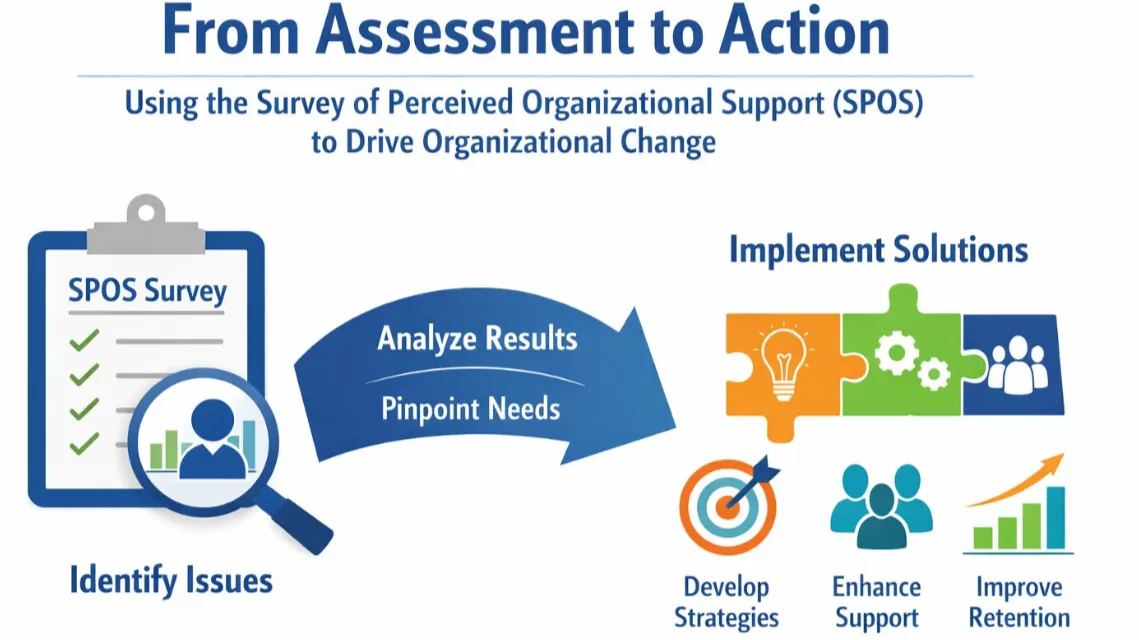
If you’re struggling with retention, the SPOS gives you diagnostic precision. Instead of guessing why people leave, you get data about how employees perceive organizational support.
A low overall SPOS score tells you organizational support is perceived as weak. Examining item-level responses tells you where- which conceptual areas are driving low perceptions.
Here’s what this data reveals: It points you toward the functional areas where organizational contingencies need attention. If employees don’t feel their contributions are valued, that’s a signal. If they don’t perceive fairness, that’s a signal. If they feel expendable, that’s a signal.
Once you understand what the SPOS data reveals, you can design targeted interventions grounded in behavior analysis. You identify the specific leadership behaviors or organizational practices that need to change. You implement them systematically. You measure along the way. And you remeasure how employees perceive organizational support.
This is the behavior-analytic approach applied to what SPOS reveals: measure, identify where support is breaking down, design interventions, measure outcomes, adjust based on data.
The Practical Next Step
If retention is a challenge in your organization, measuring organizational support through the SPOS is the logical first step. It tells you where organizational support is perceived as weak. Then, you can design targeted interventions to address the actual gaps.
Over the coming weeks, I’ll be sharing how to use SPOS data to operationalize organizational support into observable leader behaviors, and how to design interventions grounded in behavior analysis.
The SPOS is a validated tool that helps us measure organizational support, identify where it’s breaking down, and design interventions that lead to satisfied, engaged employees and improved retention.
Sources:
Eisenberger, R., Huntington, R., Hutchison, S., & Sowa, D. (1986). Perceived organizational support. Journal of Applied Psychology, 71(3), 500–507. https://doi.org/10.1037/0021-9010.71.3.500
Eisenberger, R., Shanock, L. R., & Wen, X. (2020). Perceived organizational support: Why caring about employees counts. Annual Review of Organizational Psychology and Organizational Behavior, 7, 101–124. https://doi.org/10.1146/annurev-orgpsych-012119-044917