How Role Clarity Powers Performance Systems
You can’t evaluate what you haven’t operationalized.
Most organizations evaluate people before they evaluate roles.
When performance concerns arise, leaders begin by examining the individual. Are they capable? Are they engaged? Do they align with our values? Do they really fit?
From a behavior analytic and organizational development perspective, this sequence is fundamentally flawed.
Behavior does not occur in isolation. It is shaped by role expectations, environmental constraints, feedback systems, and measurement practices. When those elements are unclear or inconsistently defined, evaluating the person is not just premature; it is methodologically unsound.
Many people decisions feel subjective or emotionally charged, not because leaders lack skill or care, but because the criteria for success were never fully specified before evaluation began.
Why people decisions feel personal
When roles are loosely defined, leaders are forced to infer expectations after the fact.
Traits replace behaviors. Intent replaces evidence. Effort replaces outcomes. Over time, this produces familiar patterns. Performance reviews feel tense. Accountability conversations escalate emotionally. Standards vary across people holding the same title.
This is not a motivation problem. It is a measurement problem.
From a behavioral perspective, valid evaluation requires observable behavior and defined outcomes. Without those elements, feedback cannot shape performance. It can only react to it. When evaluation lacks clear antecedents and criteria, both leaders and employees experience frustration and defensiveness.
Mission and values are not evaluation criteria
Many organizations believe they are evaluating objectively because they reference mission and values.
In practice, this often makes the problem worse.
Mission statements and values are typically written at a high level. They describe what the organization stands for, not what people must do in a specific role. When leaders evaluate individuals against unoperationalized values such as accountability, teamwork, or integrity, they are relying on personal interpretation.
This introduces bias, inconsistency, and confusion.
Don’t get me wrong. I would argue that aligning people with the organization's mission and values is foundational to its success. But values cannot guide performance and evaluation of that performance unless they are translated into observable behavior. Until that translation occurs, assessing values alignment is subjective by definition.
Mission and values matter deeply. They just do not function directly. They must first be converted into role-specific expectations.
Job descriptions are not role definitions
One of the most persistent misconceptions in organizations is that a job description equals a defined role.
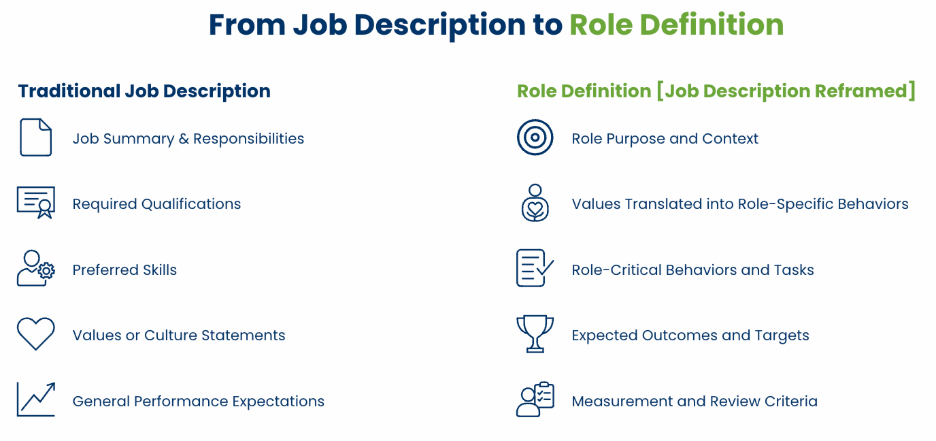
Traditional job descriptions tend to emphasize traits, broad responsibilities, and aspirational language. They describe what someone should be like, not what someone must consistently do. They rarely specify frequency, quality standards, or how success will be measured.
From a behavioral perspective, these documents do not define behavior. They describe intent.
Role definition is different. A defined role specifies how the organization's mission and values manifest as observable behavior in that specific seat. It identifies the small set of behaviors that drive success and the outcomes those behaviors must produce.
Until that exists, evaluating a person is guesswork.
Why sequence matters
In systems design, order matters.
When individuals are evaluated before roles are defined, three predictable distortions occur.
First, evaluation criteria shift midstream. Expectations are clarified during the review rather than before performance begins.
Second, evidence is interpreted to support conclusions rather than conclusions being derived from evidence.
Third, accountability feels personal, even when leaders intend to be fair and objective.
Defining the role first stabilizes the system. It fixes the target before performance is measured against it. This allows evaluation to function as feedback rather than judgment.
What must be defined before evaluating anyone
A role is not defined simply because a title exists or a job description has been posted.
Before evaluating a person, the following elements must be explicitly defined.
Role context How this role contributes to the organization’s mission and current strategic objectives.
Values translated into role-specific behavior What accountability, collaboration, quality, or other values look like in action for this role. These must be observable and specific, not trait based.
Role critical behaviors The limited set of behaviors that, if done consistently, drive success in the role.
Expected outcomes What successful performance produces in measurable terms.
Measurement criteria How performance will be evaluated, using what data, and at what cadence.
When these elements are missing or implied, evaluation becomes reactive. When they are explicit, feedback becomes clearer, earlier, and more useful.
Why leaders skip role definition
Leaders often bypass role definition because it feels slow during urgent situations. It surfaces ambiguity that has been tolerated for years. It removes the comfort of intuition and experience-based judgment.
But skipping this step does not eliminate the cost. It shifts the cost downstream into prolonged performance issues, leadership fatigue, turnover, and inconsistent people decisions.
From an organizational development perspective, role clarity is not bureaucracy. It is structural stability.
Role definition as protection
Clear role definition protects everyone involved.
It protects employees from shifting expectations and retroactive standards. It protects leaders from making decisions that feel arbitrary or personal. It protects organizations from inconsistency and risk.
When evaluation criteria are explicit and defined in advance, people decisions become defensible rather than debatable.
This is not rigidity. It is fairness.
The reframe
The problem is not that leaders are evaluating people poorly.
The problem is that evaluation is happening without a stable reference point.
When roles are clearly defined, the job description becomes more than a hiring artifact. It becomes the shared source of truth for what the role requires, how success is defined, and how performance should be evaluated over time.
The reframe is simple but consequential.
We need to stop treating the job description as a static document and start treating it as the operational definition of the role.
When the JD is built correctly, it holds all of the elements that people decisions usually struggle to invent later. It translates mission and values into observable role behavior. It identifies the small set of behaviors that actually drive success. It defines expected outcomes and how those outcomes will be measured.
Evaluation then becomes reference-based rather than judgment-based.
What changes when the JD is the anchor
When the JD is the anchor, leaders are no longer required to interpret performance on the fly. They are able to point back to agreed-upon expectations.
More importantly, employees are not left guessing.
A well-designed JD allows an employee to regularly reference the role and ask a simple question: Am I doing the work this role actually requires?
If day-to-day responsibilities begin to drift from what is defined, the JD becomes the tool for course correction. The employee can seek clarity. The manager can recalibrate expectations. Tasks and outcomes can be refined together when the role evolves.
No one should be left wondering how they are performing or whether they are hitting the targets that matter. That uncertainty is not motivating. It is destabilizing.
Clear role definition removes that ambiguity.
What doing it differently actually looks like
This reframe does not require new personalities, more motivation, or better conversations.
It requires a different sequence and a different use of the JD.
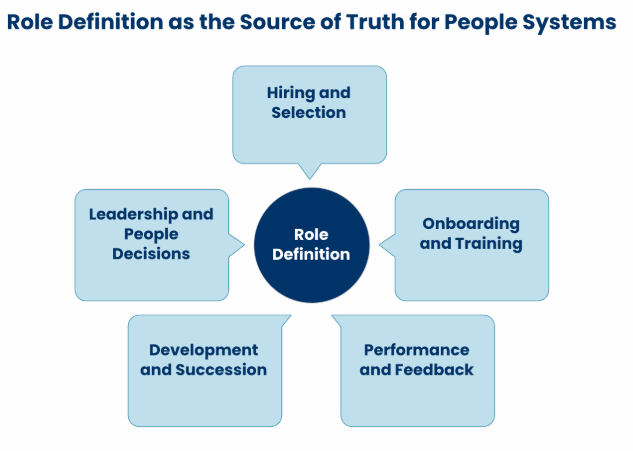
Before hiring, the JD defines how mission and values show up behaviorally in the role. This allows screening and interviews to assess actual role-relevant skills rather than relying on inferred traits or culture fit.
Before onboarding, the JD identifies the small set of behaviors that drive success. Training then focuses on those behaviors, not on generic orientation or information overload.
Before reviewing performance, the JD already contains the outcomes and metrics that define success. Reviews should compare expected and actual performance, not serve as a retrospective negotiation of standards.
Before deciding whether someone fits, the JD allows leaders to confirm that the role itself is coherent and that expectations have been clear and stable.
A strong JD also improves hiring and development simultaneously.
During screening and interviews, the JD allows leaders to assess current capability against role requirements. Upon hiring, that same information becomes the foundation for a development plan. Areas that are not yet strong can be intentionally developed during the first year rather than quietly penalized.
The JD also supports future growth. By comparing the current role to future roles, leaders and employees can identify which behaviors and outcomes must be strengthened before advancement. Development becomes preparation for readiness, not a reward for tenure.
People are placed into new roles when they are ready to succeed in them, as demonstrated by consistent performance of the required behaviors.
Why this matters
When the JD functions as the shared reference point, people decisions become clearer and fairer.
Leaders spend less time interpreting and more time supporting. Employees have a concrete way to self-assess and recalibrate. Performance conversations lose their emotional charge because expectations were defined in advance.
These are not HR steps.
They are design decisions.
And when roles are designed with this level of clarity, many of the most persistent people problems stop feeling personal and start becoming solvable.
Clear role definition is a leadership responsibility, not a courtesy. Taking the time to step back and ensure each role is clearly defined is a gift to ourselves and our teams, and involving people in that process only strengthens the clarity we all rely on.