
The Org Excel
Operating Framework.
The architecture for ABA practices that intend to function as organizations of excellence.
It applies the science of behavior analysis to the work of running the organization, the same way the field applies it to the clients it serves. The framework is documented in the foundational white paper, The Behavioral Blueprint for an Organization of Excellence: A Behavioral Systems Approach for ABA Practice Owners, and developed at length in the companion reading Organizational Excellence: The Science Behind the Framework.
The Foundation:
OBM + BSA
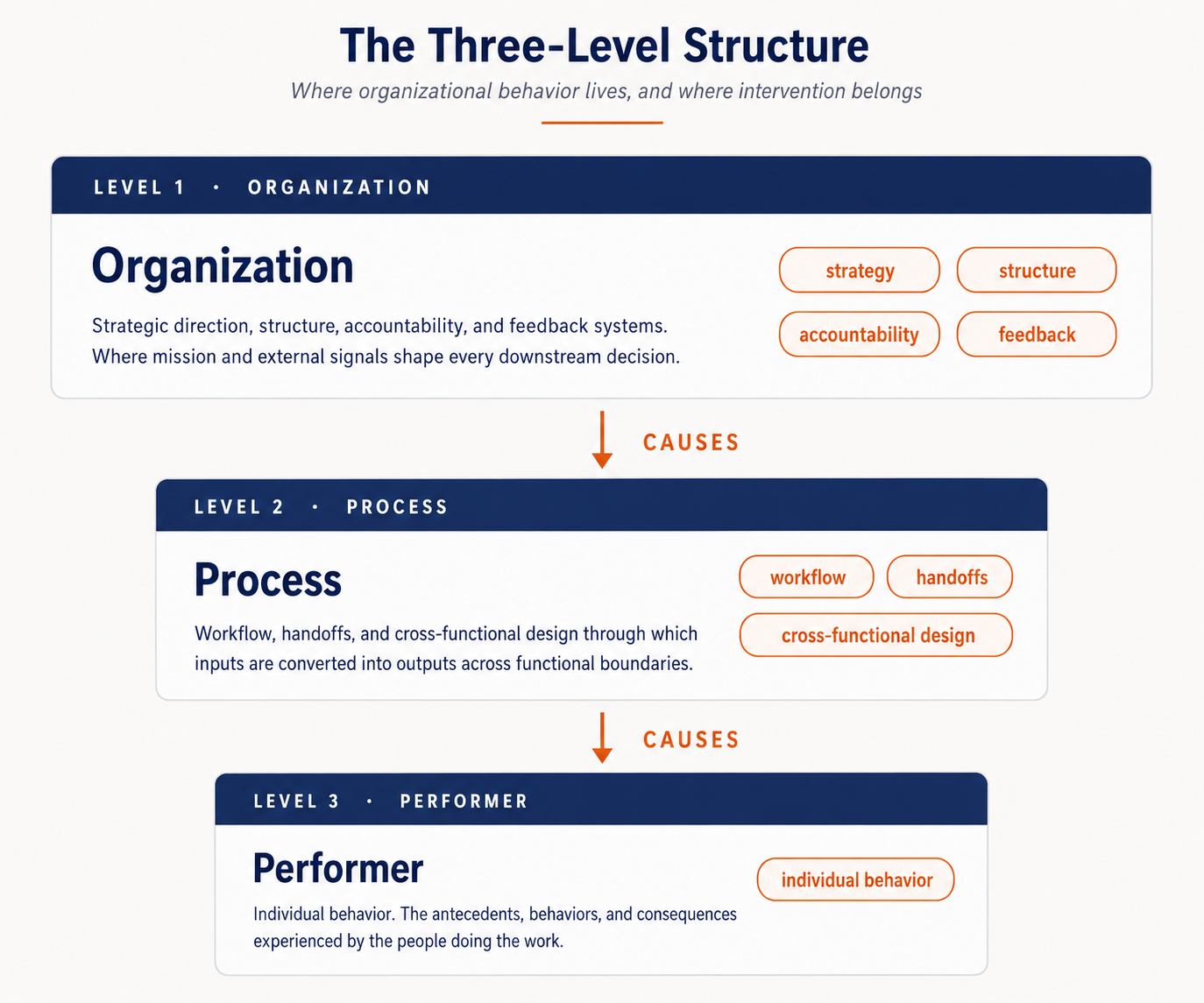
In addition to organizational research, the framework draws heavily on two areas of behavioral science. Organizational Behavior Management (OBM) is the application of behavior analytic principles to organizational performance, including hiring, supervision, performance management, training, and reinforcement systems. Behavioral Systems Analysis (BSA) is the methodology for analyzing organizational performance at three levels: organization, process, and performer.
OBM and BSA together provide the theoretical and methodological foundation for everything the framework operationalizes. OBM supplies the technologies. BSA supplies the structure for knowing where to apply them.
The Behavioral Systems Analysis lineage runs from Baer, Wolf, and Risley's foundational dimensions of applied behavior analysis (1968), through Brethower's Total Performance System (1972), Mawhinney's integration of continuous improvement with operant principles (1992), Rummler and Brache's Super-System framework (1995), Glenn's metacontingency (2004), Diener, McGee, and Miguel's integrated BSA framework (2009), and McGee and Crowley-Koch's comprehensive treatment of BSA in health and human services (2019). The framework presented here is built on the methodological foundation those five decades established.
Eleven domains. Three clusters.
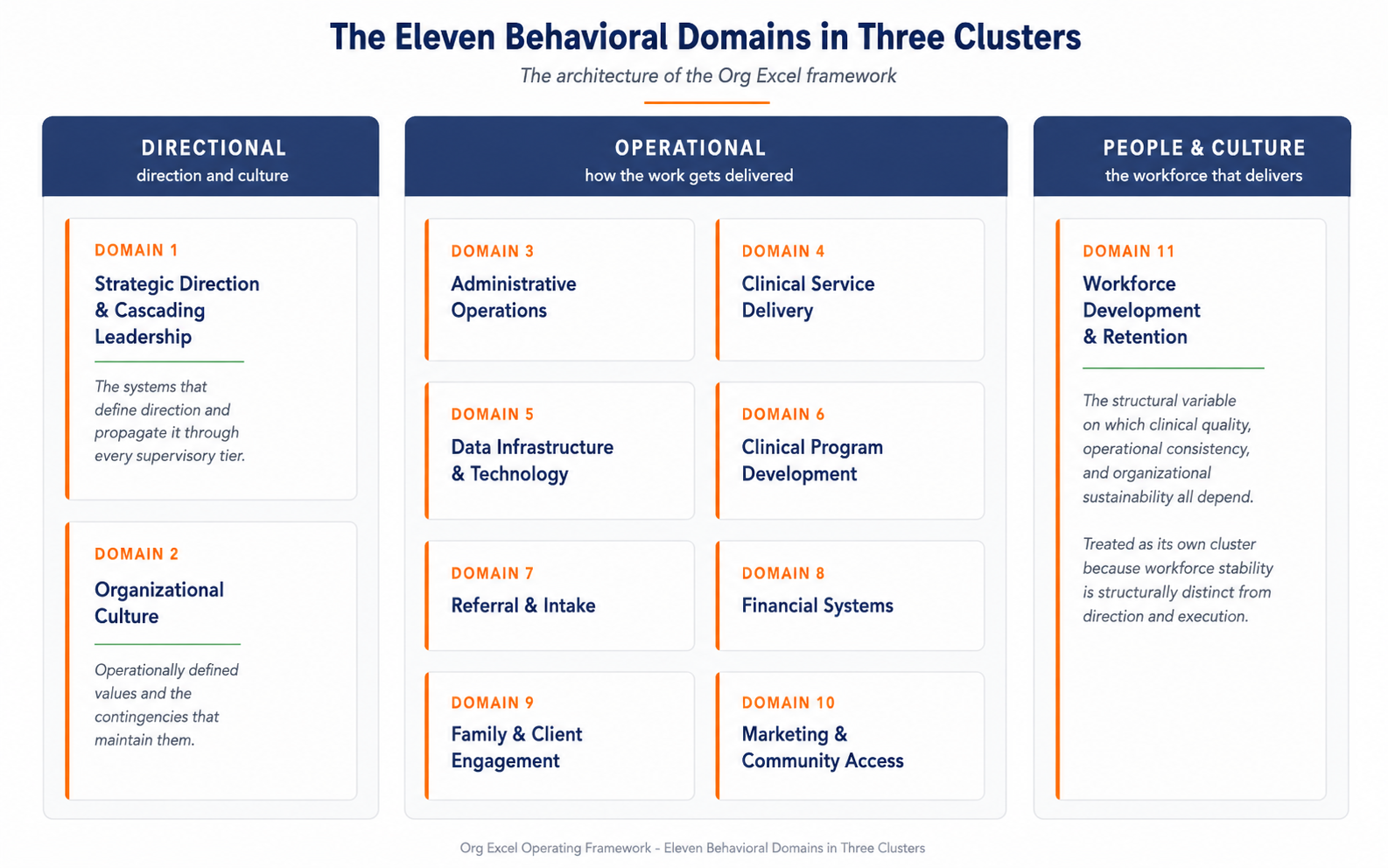
The framework organizes the work of an ABA practice into eleven behavioral domains, grouped into three functional clusters: Directional, Operational, and People & Culture.
Each cluster has a distinct role in how the organization functions, and each domain within a cluster represents a defined area of behavioral system design.
Directional
Direction and culture
Addresses the systems through which an organization defines its purpose and translates that purpose into observable behavior at every supervisory level. Two domains constitute this cluster: Strategic Direction and Cascading Leadership, and Organizational Culture. The Directional cluster is the cluster from which the other nine domains take their shared behavioral context.
Operational
How the work gets delivered
Addresses the systems through which the practice delivers services, manages resources, sustains business viability, and converts referrals into long-term client and family relationships. Eight domains constitute this cluster: Administrative Operations, Clinical Service Delivery, Data Infrastructure and Technology, Clinical Program Development, Referral and Intake, Financial Systems, Family and Client Engagement, and Marketing and Community Access. The Operational cluster is the execution layer of the organization.
People & Culture
The workforce that delivers
Addresses the workforce systems through which the organization attracts, develops, retains, and reinforces the people who deliver the care. One domain constitutes this cluster: Workforce Development and Retention. This domain is treated as its own cluster because workforce stability is the structural variable on which clinical quality, operational consistency, and organizational sustainability all depend.
Three levels of analysis.
Within every domain, work is analyzed at three levels: the organization, the process, and the performer. Organization-level conditions produce process-level outcomes, which produce performer-level results. The arrow runs from the outside in. Performer-level interventions remain valid for performer-level problems, but they cannot resolve problems that originate upstream. The framework specifies indicators at all three levels within each domain so that intervention happens at the level where the problem actually lives.
Four developmental stages.
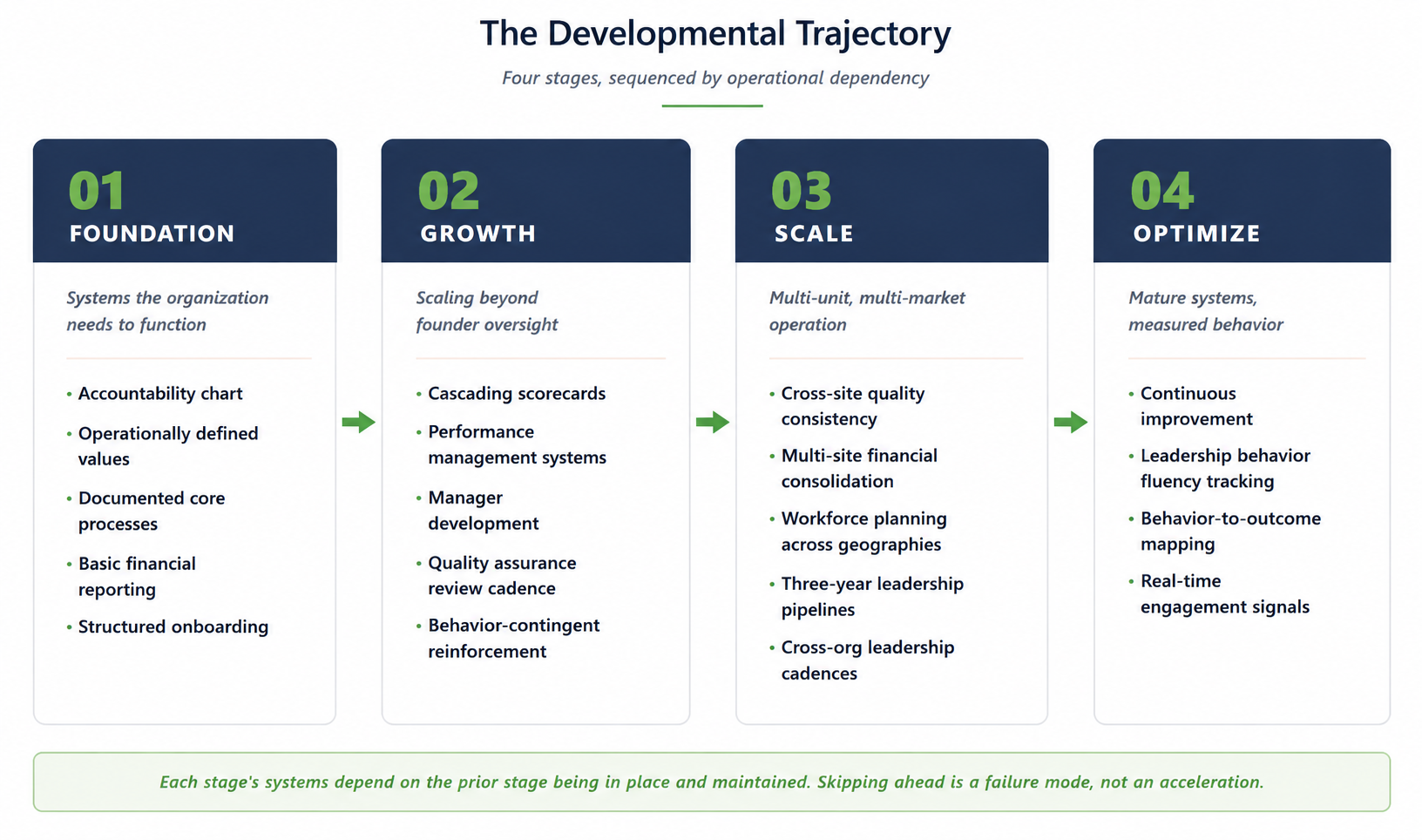
Practices move through four sequenced stages of organizational development: Foundation, Growth, Scale, and Optimize. The eleven behavioral domains are overlaid with these four developmental stages that describe how organizations mature over time, and all eleven domains exist at every developmental stage. What changes from Foundation to Optimize is the complexity and depth of work inside each domain, not the presence or absence of the domain itself.
Systems the organization needs to function.
The stage at which the practice establishes the systems that keep operations stable and predictable. Workforce hiring, financial discipline, clinical documentation, and supervisory infrastructure are installed at Foundation before the practice attempts meaningful growth.
Scaling beyond founder oversight.
The stage at which the practice adds clinics, staff, or service lines, and the systems built at Foundation are extended to support multi-site operations, hiring governance, and the cadence of measurement that growth requires.
Multi-unit, multi-market operation.
The stage at which the practice operates at multi-site complexity, with leadership development and operational depth that allow the founder to step out of daily operations while the organization continues to function and grow.
Mature systems, measured behavior.
The stage at which a mature practice runs on continuous improvement, leadership mastery, and the operational sophistication to meet both clinical mission and organizational goals on the founder's terms.
Cascading leadership.
Eleven domains listed together do not constitute an organizational health framework. What makes them a system is the behavioral mechanism that sustains performance across all of them simultaneously, without requiring founder-level oversight of each.
That mechanism is cascading leadership, defined as the systematic operationalization of defined behavioral expectations at every supervisory level of the organization, with monitoring, feedback, and contingent reinforcement ensuring that organizational direction translates into observable performer behavior from the ownership level through the front line. When leadership behavior cascades through the practice, the eleven domains function as a coherent organizational system rather than as eleven independent programs.
Section Six
The ABLF.
Under peer review at JOBMThe Applied Behavioral Leadership Framework (ABLF) is a separate but integral tool within Org Excel. It is a leadership development model that operationalizes leadership as observable, measurable behaviors and provides the developmental architecture through which leaders at every level of the organization are built.
The ABLF stands on its own as a leadership development tool that any individual leader can use. Inside an organization of excellence, it provides the cascading behavioral infrastructure the framework depends on. Organizations that operationalize the ABLF develop leaders continuously at every supervisory level, not only at the executive layer. The ABLF manuscript is currently under review at the Journal of Organizational Behavior Management.
The research basis.
Every domain in the framework is grounded in peer-reviewed literature across organizational behavior management, organizational psychology, human service management, and behavioral systems analysis. The Behavioral Blueprint for an Organization of Excellence maps each domain to its research anchors, observable behavioral indicators at each level of analysis, and the OBM technologies that translate research into operational practice. The framework is a synthesis, not an invention. The contribution is the structure that integrates the literature into a coherent organizational system specific to ABA practice settings.
For the complete scientific treatment, including the BSA lineage, Brethower's Total Performance System, the convergent organizational diagnostic tradition, and the three-step assessment-and-intervention protocol drawn from Malott's ASDIER, see the companion reading Organizational Excellence: The Science Behind the Framework.
Talk With Us
The right first step is a conversation.
About where your practice is, where you want it to go, and whether Org Excel is the right framework to get you there.
Company
Contact Us
© Copyright 2026. Org Excel. All Rights Reserved.